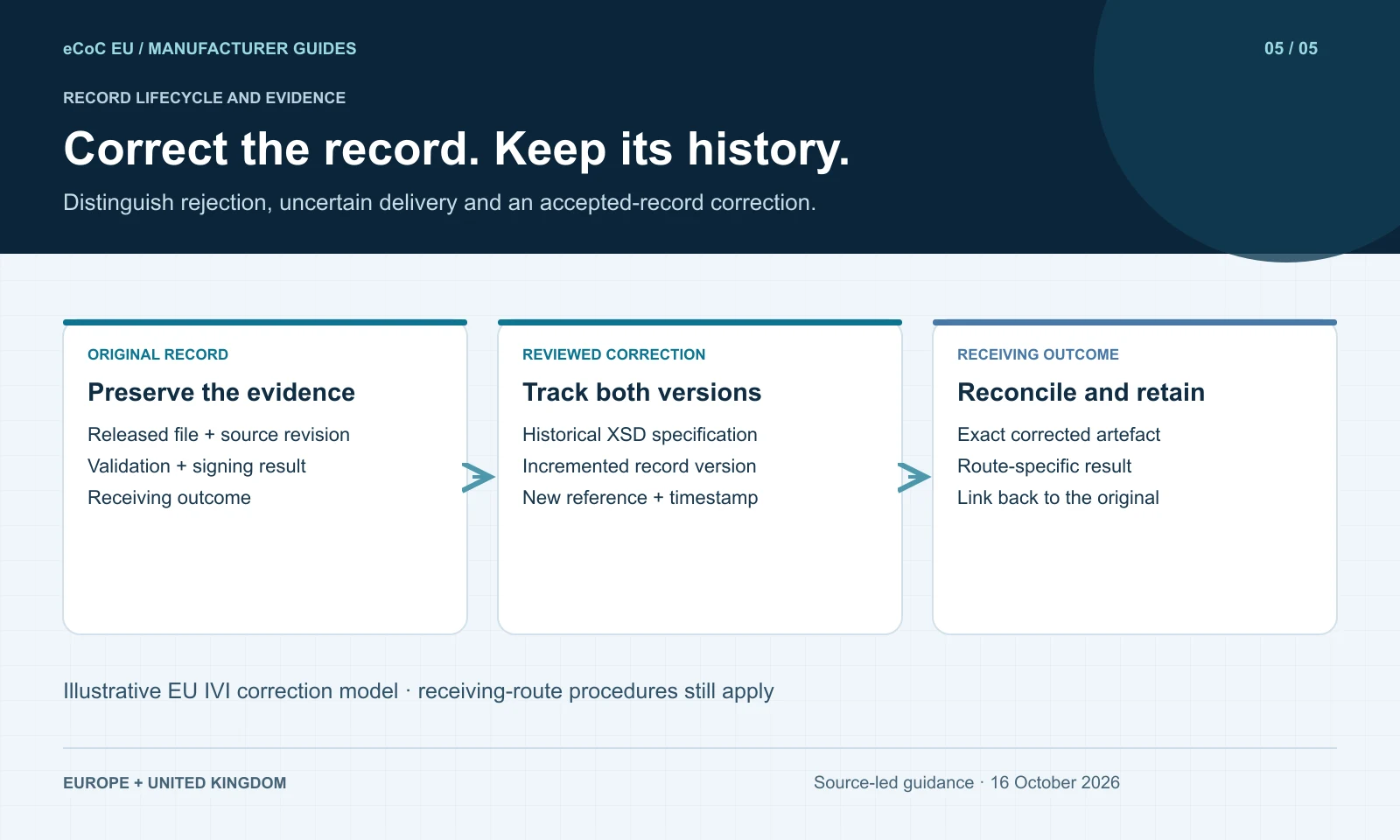
An eCoC correction should start by establishing what the receiving system has already accepted. For the EU IVI correction model, EReg guidance retains the original XSD version, increments the record version, creates a new reference and updates the message timestamp. Revalidate and release the corrected file, then retain the receiving outcome alongside the original.
First determine what actually happened to the original file
A rejected upload, an unanswered request and an accepted record containing an error are different situations. The operator needs the original file, transmission reference and returned status before deciding whether to correct, retry or investigate.
If a request timed out, do not infer that the receiving system stored nothing. Reconcile the outcome using the supported status or enquiry process before another transmission. This avoids turning a network uncertainty into duplicate records or an unexplained version history.
| Observed state | First action | Evidence to retain |
|---|---|---|
| Local check failed | Correct the source before external submission. | Failed check, reviewed change and new validation result. |
| Receiving system rejected the file | Read the actual response and resolve the stated cause. | Rejected artefact, response and approved next attempt. |
| Delivery outcome is uncertain | Reconcile the existing transmission using the receiving route's supported procedure. | Request reference, timing and reconciliation result. |
| Accepted record needs correction | Use the destination's versioned correction procedure. | Original record, reason for change, replacement record and receiving outcome. |
This table is a manufacturer operating aid. It does not define universal authority status codes or a generic delete operation. The interface's published rules remain the source for what an accepted record can do next.
IVI record version and XSD version mean different things
The XML schema version identifies the specification used to express the record. The record version identifies a successive version of the vehicle's conformity message. Updating a corrected record does not automatically mean migrating it to the newest schema.
Sections 1.10–1.12 of the EReg IVI 2.0 guidelines v1.1 describe historical-version handling and corrections. The IVI NAP manufacturer FAQ also addresses a correction made years after the original. Keep a copy of the specification used for the original release and confirm the receiving route's current procedure for that historical version.
| Item | Original accepted record | Reviewed correction |
|---|---|---|
| Vehicle identity | The original vehicle's VIN | The same vehicle identity, subject to the route's specific identity-correction procedure if needed |
| XSD version | Original specification | Original specification retained under the cited IVI correction model |
| Record version | 1 | 2 |
| Reference ID | SYNTHETIC-A | SYNTHETIC-B — a new reference |
| Message timestamp | Original issue time | Time the correction is prepared |
| Changed characteristic | Previously released value | Reviewed replacement value with source evidence |
The example uses readable labels rather than a fabricated production VIN or a shortened XML file. Use the exact field names, hierarchy and value constraints from the applicable specification when implementing the mapping.
Correct the source and assess the affected vehicles
Find out whether the error belongs to one individual vehicle, a reusable template or a shared mapping. If a template supplied an incorrect value, identify every released record that used the affected revision. Correcting only the first reported VIN can leave the same problem elsewhere.
The responsible reviewer should record the changed value, supporting evidence and reason. A later physical modification is not automatically a correction to the original manufacturing conformity information. Determine the appropriate regulatory process before attempting to rewrite a historical record.
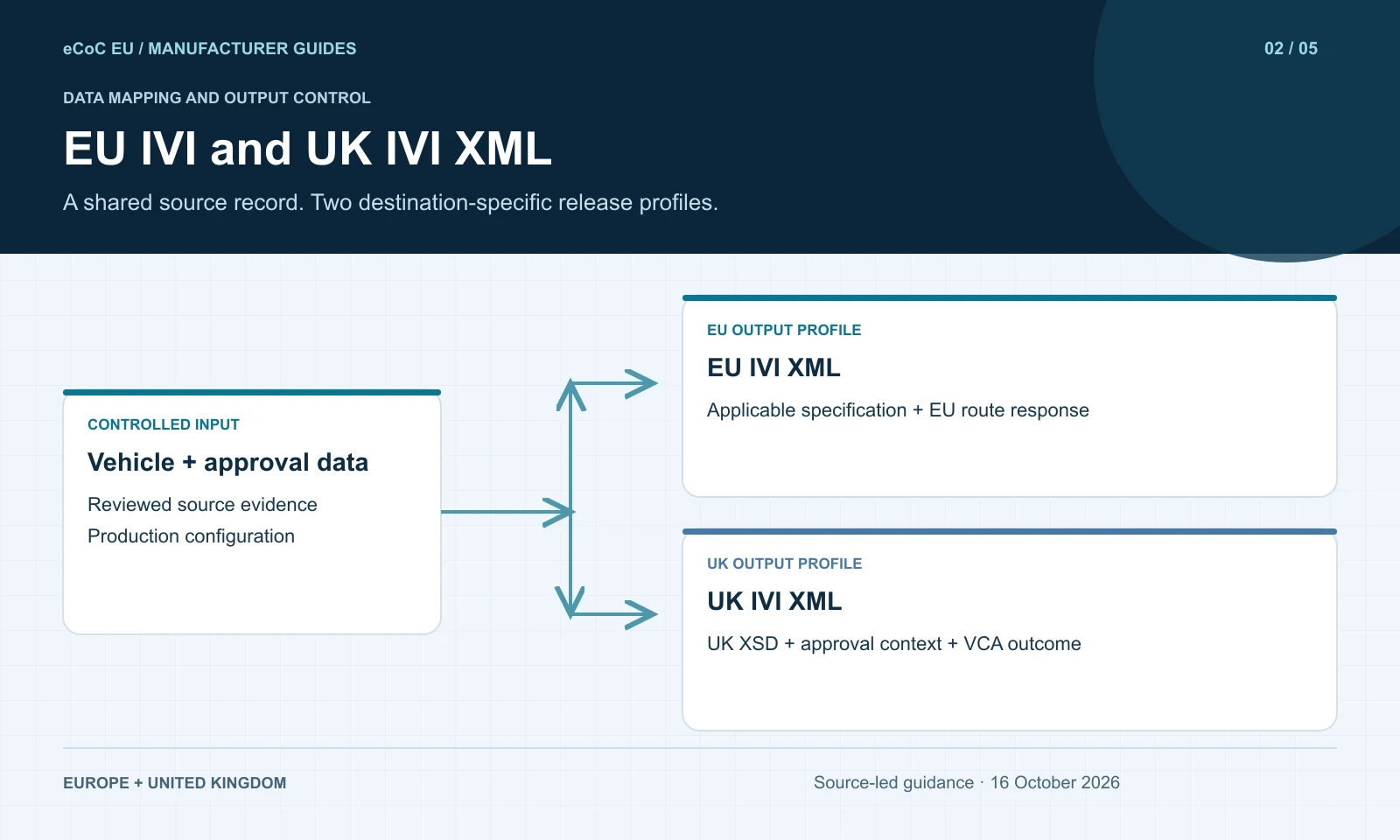
For a jurisdiction comparison before regenerating outputs, use the EU and UK IVI XML guide. A change to shared source data may require assessment in both export profiles, even when the incident was reported in only one market.
A controlled correction and resubmission sequence
- Preserve the original. Retain its released file, source revision, checks, signing evidence and receiving outcome.
- Approve the change. Identify the affected field, evidence, reviewer and scope of impacted vehicles.
- Select the correction profile. Use the applicable historical specification and destination-specific versioning rules.
- Regenerate and validate. Run the relevant structural, consistency and manufacturer evidence checks against the corrected output.
- Release the final artefact. Apply the required signing process to the final file; preserve the result with its version.
- Submit and reconcile. Capture the new transmission and receiving outcome, linking them to the original record.
- Close downstream actions. Record any customer or registration-team follow-up that the responsible process requires.
The sequence is a recommended manufacturer control pattern. It should be implemented with the exact receiving procedure and the organisation's approval responsibilities, rather than translated into an assumed universal API.
How do EU and UK correction paths differ?
The EUCARIS implementation guidance describes correction notifications in the European exchange network. That network behaviour should not be presented as an action the manufacturer can independently trigger in every connected national registration system.
The VCA's versioning FAQ confirms support for multiple versions and identifies IviVersionNumber in duplicate handling. Use the UK procedure for a UK record. Do not infer that a successful UK version update replaces an EU record or fulfils a separate national follow-up.
Test the correction path before production use
Include an accepted-record correction and an uncertain-transmission case in the implementation acceptance exercise. The operator should be able to locate the original, explain the new version and show which receiving result closes the incident.
For batch issues, ask how the team identifies the affected population, reviews the proposed changes and prevents unreviewed bulk release. These controls matter even when the interface accepts each file technically. A successful transmission is evidence of a transmission outcome, not proof that the amended characteristics were appropriate.
Connect the correction procedure to your eCoC software workflow and the manufacturer NAP submission process. Bring a redacted original, its actual response and the intended correction scenario to a scoped review.
Frequently asked questions
Should a corrected IVI record use the latest XSD?
The cited EU IVI correction guidance retains the original XSD version. Confirm how the chosen receiving route handles that historical specification. Track the schema version separately from the corrected record's version.
Can we edit the XML after it has been signed?
Changing signed content can invalidate its signature. Regenerate and validate the corrected output, then apply the required signing and release process to the final artefact. Keep the previous signed record unchanged in the history.
Does a timeout mean we can immediately send the file again?
No outcome should be assumed from a timeout alone. Use the supported reconciliation procedure to establish whether the receiving system already accepted the request, then follow the appropriate retry or correction path.
For the wider responsibility chain, continue with the eCoC and IVI knowledge hub.
Official and technical references
These sources support the regulatory and technical statements in this guide. Always check the current consolidated text and the instructions of the authority responsible for your submission route.