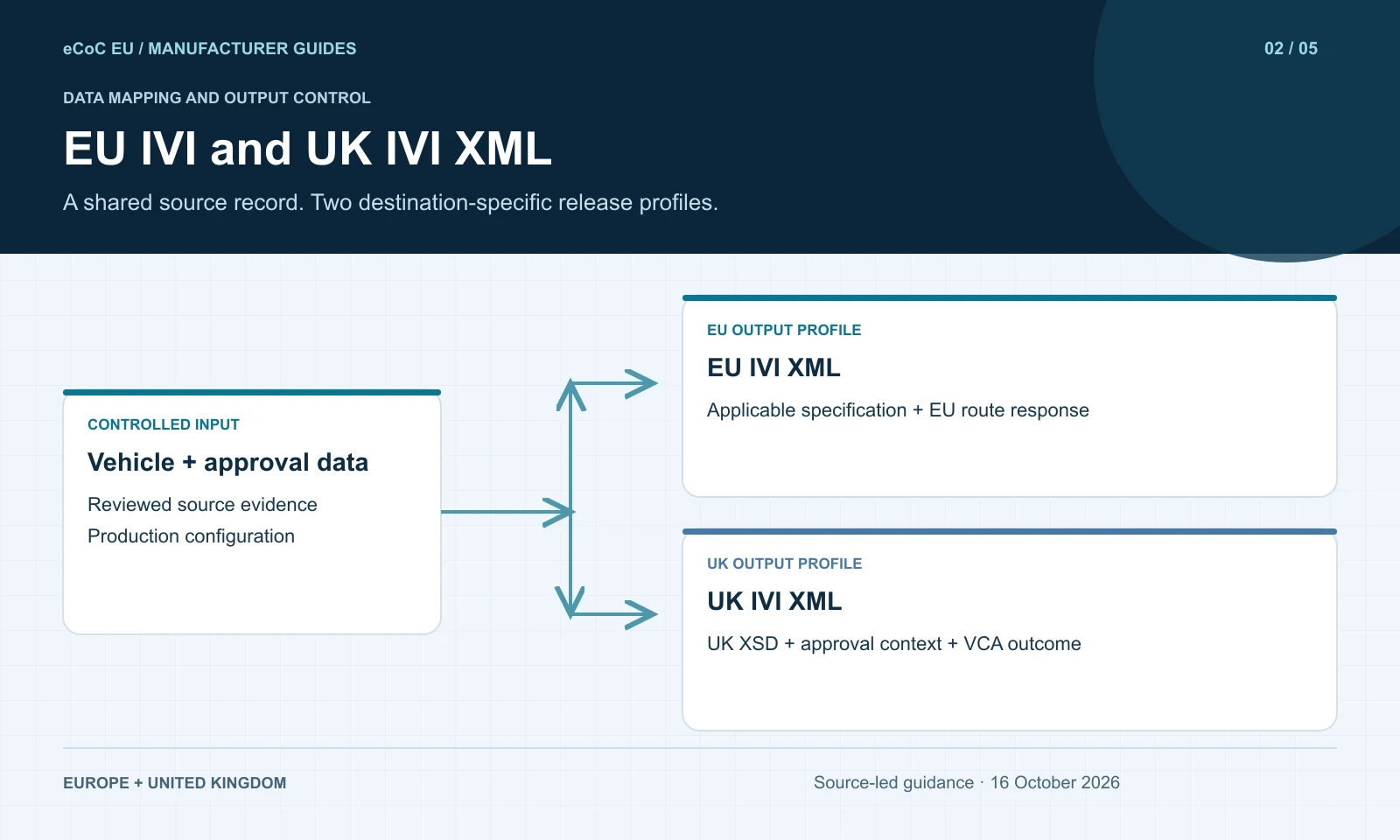
EU IVI and UK IVI XML share an IVI 2.0 foundation, but an EU eCoC file should not be assumed suitable for UK submission. Prepare the output against the destination's XSD and approval context. Reuse verified source data, then validate and release each destination-specific file separately.
What is shared, and what needs its own mapping?
The common starting point is the vehicle's approved configuration and its production record. Identity, technical characteristics and approval evidence should be managed coherently before either XML output is built. This avoids correcting a value in one export while leaving the other market's output inconsistent.
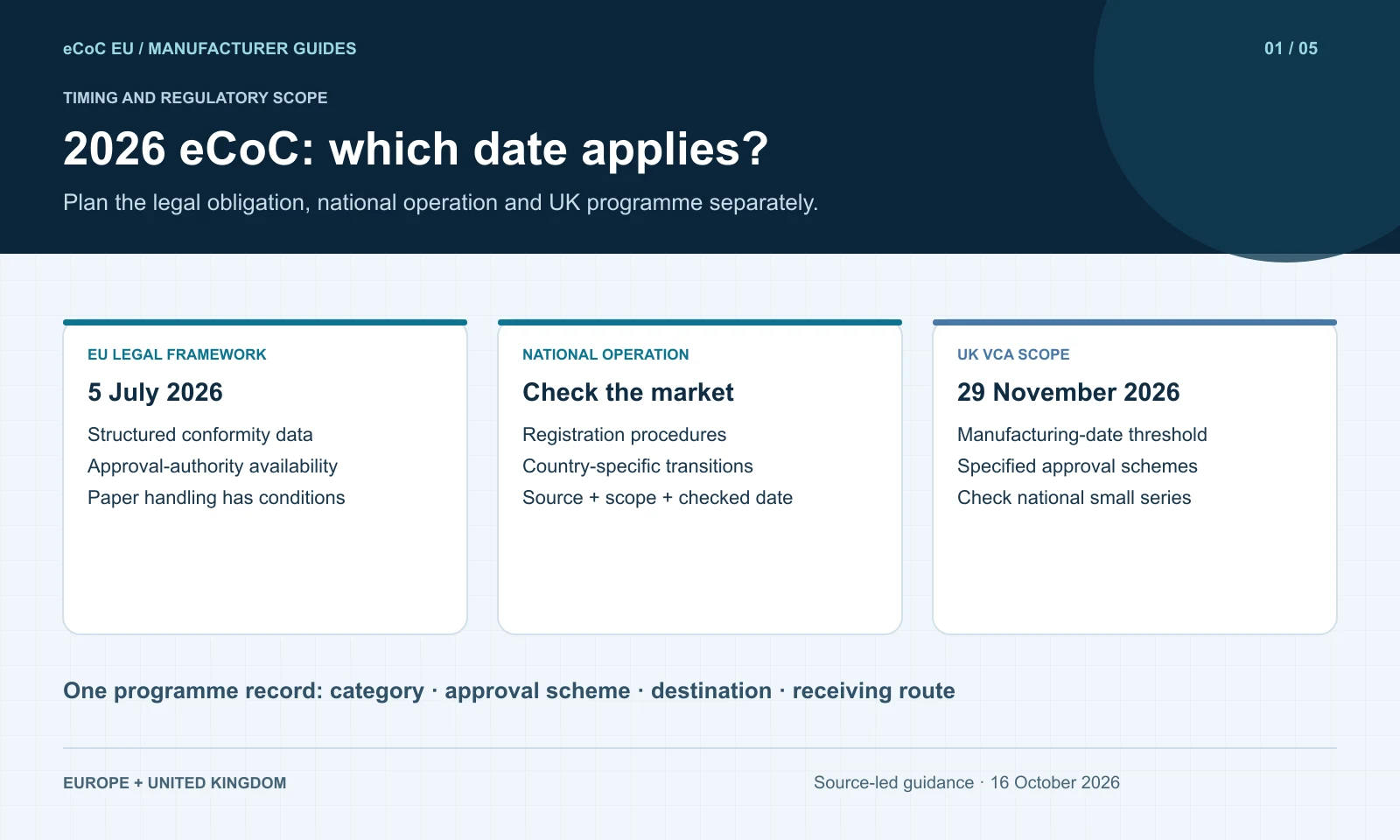
The exchange specification is a separate layer. The EU electronic CoC format and exchange rules provide the regulatory context for IVI. The UK implementation has its own published schema and instructions. Treat these as versioned requirements in the export process, with a recorded source and effective configuration.
| Control | EU programme | UK programme |
|---|---|---|
| Specification | Use the IVI specification accepted by the chosen EU route. | Use the UK IVI XSD published by VCA. |
| Approval context | Preserve the applicable EU approval and authority references. | Represent the applicable GB or UKNI approval; do not relabel an EU approval. |
| Code lists | Check the EU version's enumerations. | Check UK additions, including relevant approval-country and scheme options. |
| Delivery | Manufacturer access point and authority exchange requirements apply. | VCA Portal/API and manufacturer-account requirements apply. |
| Evidence | Keep the EU file and route-specific response. | Keep the UK file and VCA outcome separately. |
Which UK IVI fields deserve specific attention?
The VCA's UK-specific IVI guidance identifies additions to TypeApprovalCountryCode, TypeApprovalTypeCode and GeneralCodeEcoInnovationCode. Examples include g11, n11 and UK approval-scheme enumerations. It also explains how retained EU-named representative, country and language elements are completed for UK records.
Build a mapping register with four columns: source evidence, export field, transformation rule and approving owner. The source for an approval code should be the applicable approval documentation. Do not derive it from the customer's postal address, registration country or the language used in a sales order.
For every conditional field, write down when it is present and which source determines the value. “Not applicable” and “not yet supplied” are different data states. An empty source cell should trigger review rather than silently becoming a convenient default in both exports.
Design one source record with two controlled outputs
- Freeze the approved input. Associate the vehicle configuration and production values with the approval revision used for release.
- Select the destination profile. Record jurisdiction, approval scheme, XSD version and receiving route as explicit configuration.
- Apply the mapping. Reuse common values while applying destination-specific code lists and conditional rules.
- Validate the exact output. Store checks against the file actually being released, not an earlier draft.
- Apply the signing workflow. Any later data modification requires review of the signed artefact and a new release through the applicable process.
- Capture the receiving outcome. Link the final file and response to the correct destination profile and vehicle.
The eCoC XML guide explains the structured-data layer. Use the eCoC and IVI knowledge hub to keep the relationship between the certificate, message format and exchange service clear.
How to generate eCoC XML
Learn how to generate eCoC XML and review XSD and ICM validation results.
Example: testing a GB profile without altering the EU profile
Suppose a manufacturer adds a GB approval profile to an existing EU vehicle programme. A useful test begins with a reviewed reference vehicle and a list of destination-specific expectations. Export both records from the same controlled source, then compare the resulting field values against those expectations.
The test should detect an unsupported approval enumeration, an omitted representative value and a source record that has changed since review. These are deliberately constructed acceptance cases; they are not a list of official VCA error codes. Keep the expected result and actual outcome for each case.
Do not provide a shortened XML fragment as a production-ready example. A few plausible-looking tags cannot demonstrate the complete namespace, hierarchy, required groups or signature requirements. Use the published XSD and an appropriately redacted full sample in the integration test.
Submission channels and validation are separate decisions
Choosing XML tooling does not create permission to send a file. The selected account and interface must belong to the intended manufacturer process. A service provider's demonstration account is not proof that the manufacturer's production account is ready.
Equally, schema validation checks the representation, while internal approval and production checks establish whether the selected values are supported by evidence. The EUCARIS implementation guidance describes the European exchange context; it should not be used as a substitute for UK account and interface instructions.
Technical acceptance review: what to check
Ask the implementation team to identify the schema version, show where destination-specific rules are maintained and demonstrate a rejected-record correction. Check who owns a future specification update and whether the old released output remains retrievable afterwards.
For programmes serving both markets, require separate release evidence rather than a single combined status. A vehicle may be ready for one destination while the other profile remains blocked by missing approval data, account configuration or a failed check.
Review the UK IVI and VCA workflow with your approval scheme and a redacted sample. For a shared source-data operating model, explore manufacturer eCoC software. Include both destinations in the agreed acceptance cases.
Frequently asked questions
Can an EU IVI XML file be uploaded unchanged to VCA?
Do not assume it can. The file must meet the UK IVI XSD and contain the correct approval context. Whether particular source values can be reused depends on the vehicle programme and the UK requirements that apply.
Can we generate both files from the same database?
Yes, a shared controlled source can support separate export profiles. Keep jurisdiction-specific transformations explicit, validate each final file and retain its own release and submission evidence.
Is a schema-valid file enough to approve a vehicle record?
Schema validity does not establish that its values match the approved vehicle and actual production configuration. Those checks, signing and receiving-system outcomes remain separate controls.
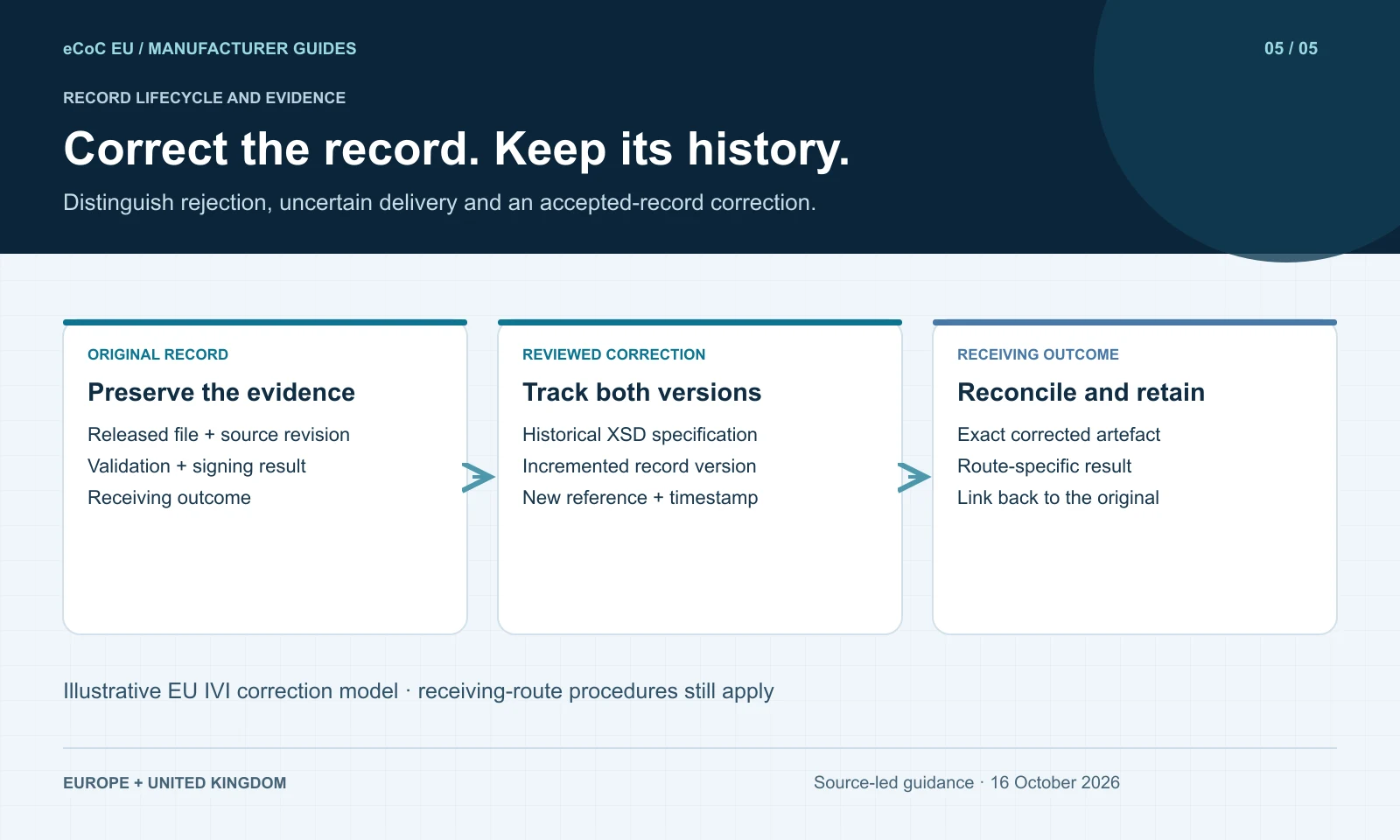
Plan the later lifecycle too: the submitted eCoC correction guide explains why a record version and an XML schema version must be tracked independently.
Official and technical references
These sources support the regulatory and technical statements in this guide. Always check the current consolidated text and the instructions of the authority responsible for your submission route.