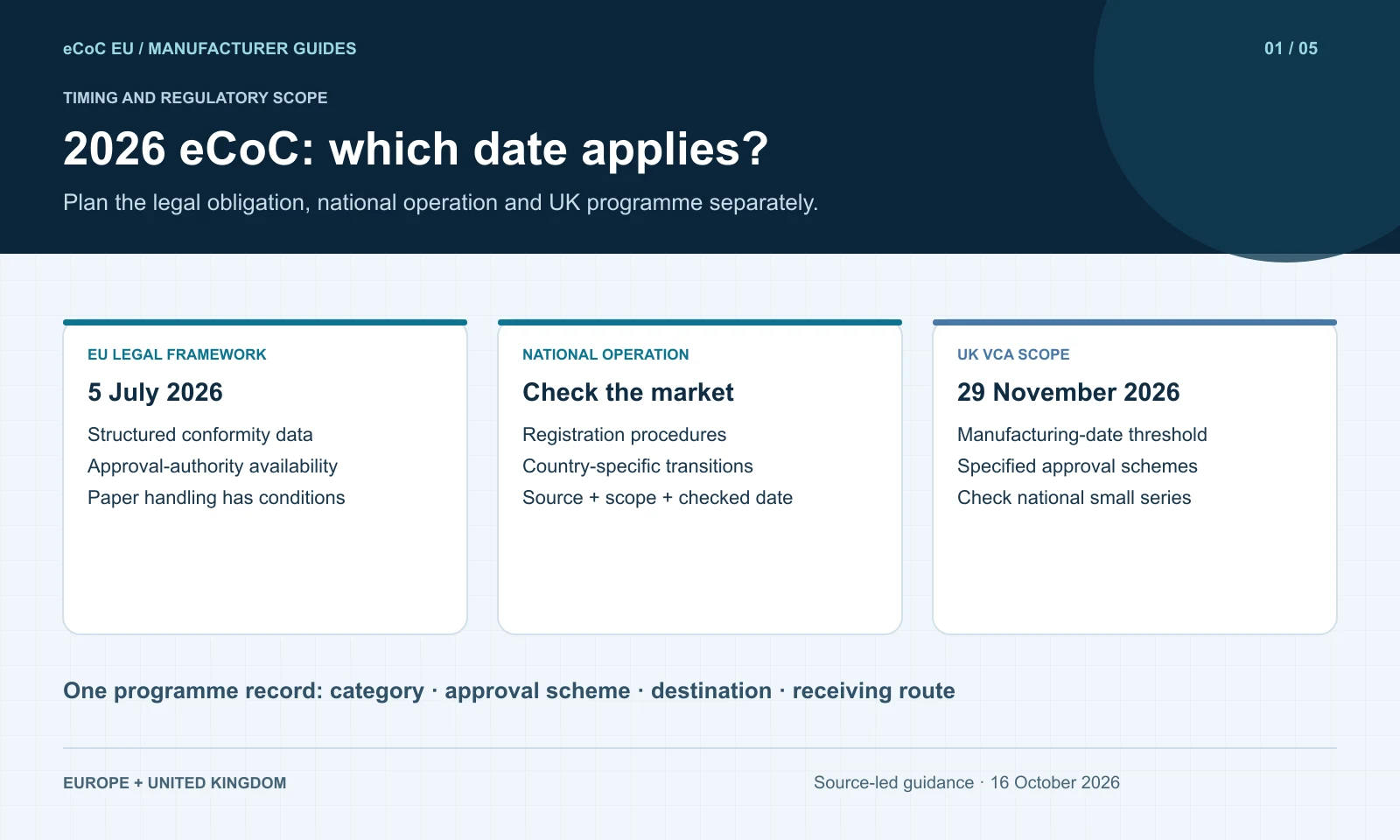
The eCoC deadlines in 2026 cannot be reduced to one date for every European vehicle programme. The EU framework retains 5 July 2026, while national authorities describe transitional registration arrangements. UK VCA guidance sets 29 November 2026 for newly manufactured vehicles within its specified approval schemes. Check the applicable route before stopping paper CoCs.
Which eCoC date applies to your vehicles?
Start with the approval under which the vehicle is manufactured, then identify the receiving approval authority and registration market. A sales destination alone does not identify the correct submission route. An EU-approved vehicle exported to Great Britain and a GB-approved vehicle built for the domestic market may require different handling.
Keep three entries in the launch plan: the legal obligation, the receiving system's operational instruction and the customer's registration procedure. Record a source and a checking date for each. This prevents a temporary registration concession from becoming an unsupported company-wide exemption.
| Scope | Published position | Manufacturer planning consequence |
|---|---|---|
| EU framework | Article 37(1) of Regulation 2018/858 specifies 5 July 2026 for structured electronic CoC availability. | Retain the legal date in your compliance register; assess the national operating instructions separately. |
| Romanian transition notice | RAR describes a coordinated implementation transition ending no later than 29 November 2026; countries may implement earlier. | Do not describe the notice as an amendment postponing EU law everywhere. |
| Irish registration | Revenue describes transitional options through 29 November and IVI 2.0-only acceptance from 30 November 2026 for the stated new M/N registration process. | Check the registration market as well as the approval authority's receiving route. |
| UK VCA | 29 November 2026 is the manufacturing-date threshold for vehicles within the specified GB/UKNI schemes. | Do not use a later registration date to decide whether a pre-threshold vehicle is in scope. |
The EU baseline is in Articles 36 and 37 of the current consolidated framework. The RAR implementation notice and Irish Revenue procedure illustrate why a national transition needs its own row. They describe different administrative contexts, rather than a single interchangeable European rule.
When can paper CoCs still matter?
Under Article 36(2), the EU exemption from supplying the accompanying paper CoC is linked to making the structured electronic certificate available in accordance with Article 37(1). Article 37(10) also provides for exceptional national-authority requests for a paper duplicate. A generated XML file sitting in a manufacturer's folder does not establish that the receiving requirement has been met.
For each programme, ask the registration team to document the paper fallback that actually applies. Define who can request it, who approves it and how the paper document remains aligned with the released electronic record. Avoid creating two independently editable versions of the same vehicle's conformity data.
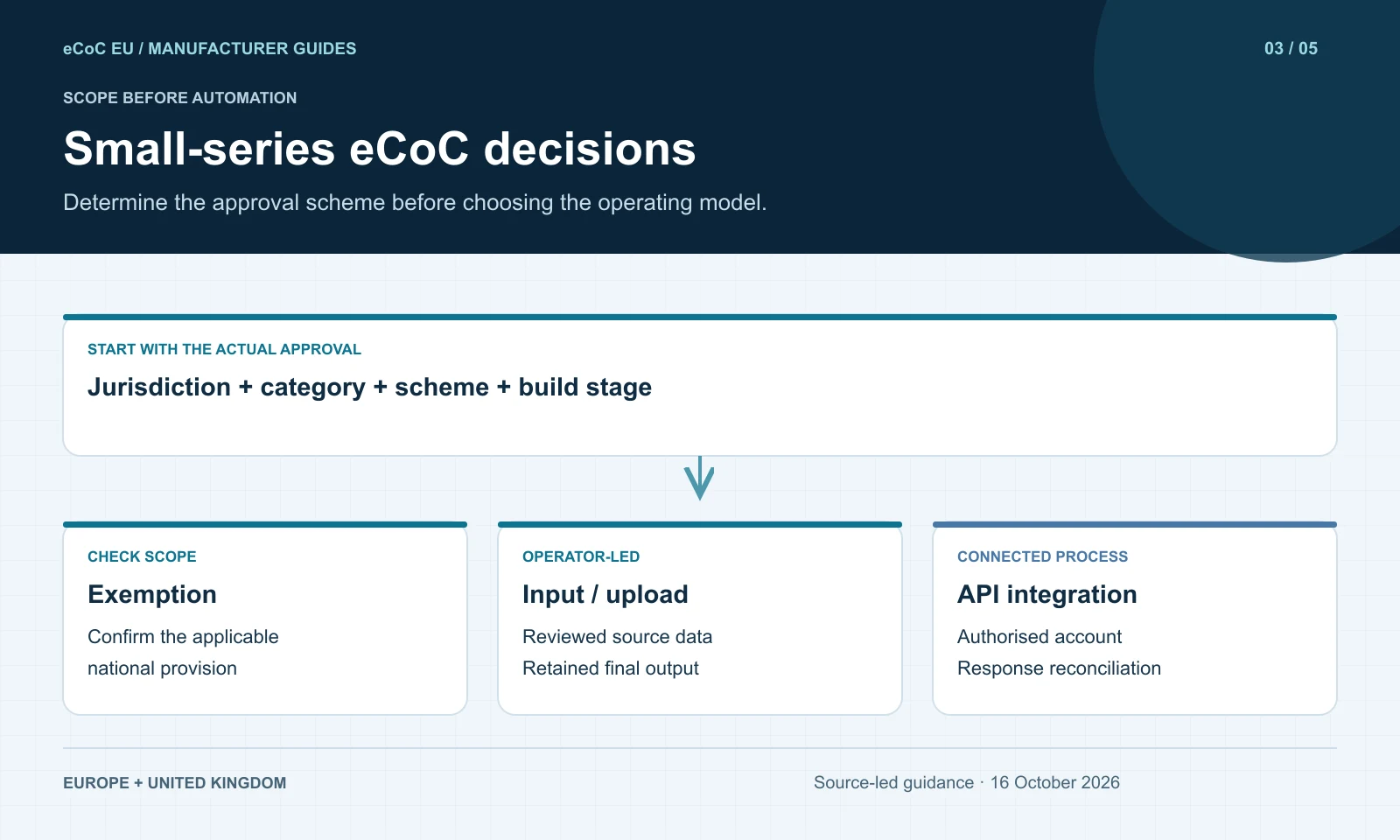
UK paper handling must follow the VCA's own scope and paper-CoC guidance. In particular, the manufacturing threshold and national small-series exceptions need checking against the approval scheme. A UK rule should not be copied into an EU market procedure.
A readiness checklist for the manufacturer
- Define the programme. Record vehicle category, complete/incomplete/completed status, approval scheme, approval number and manufacturing entity.
- Confirm the route. Identify the EU access point or UK account, the authorised users and the owner of the onboarding evidence.
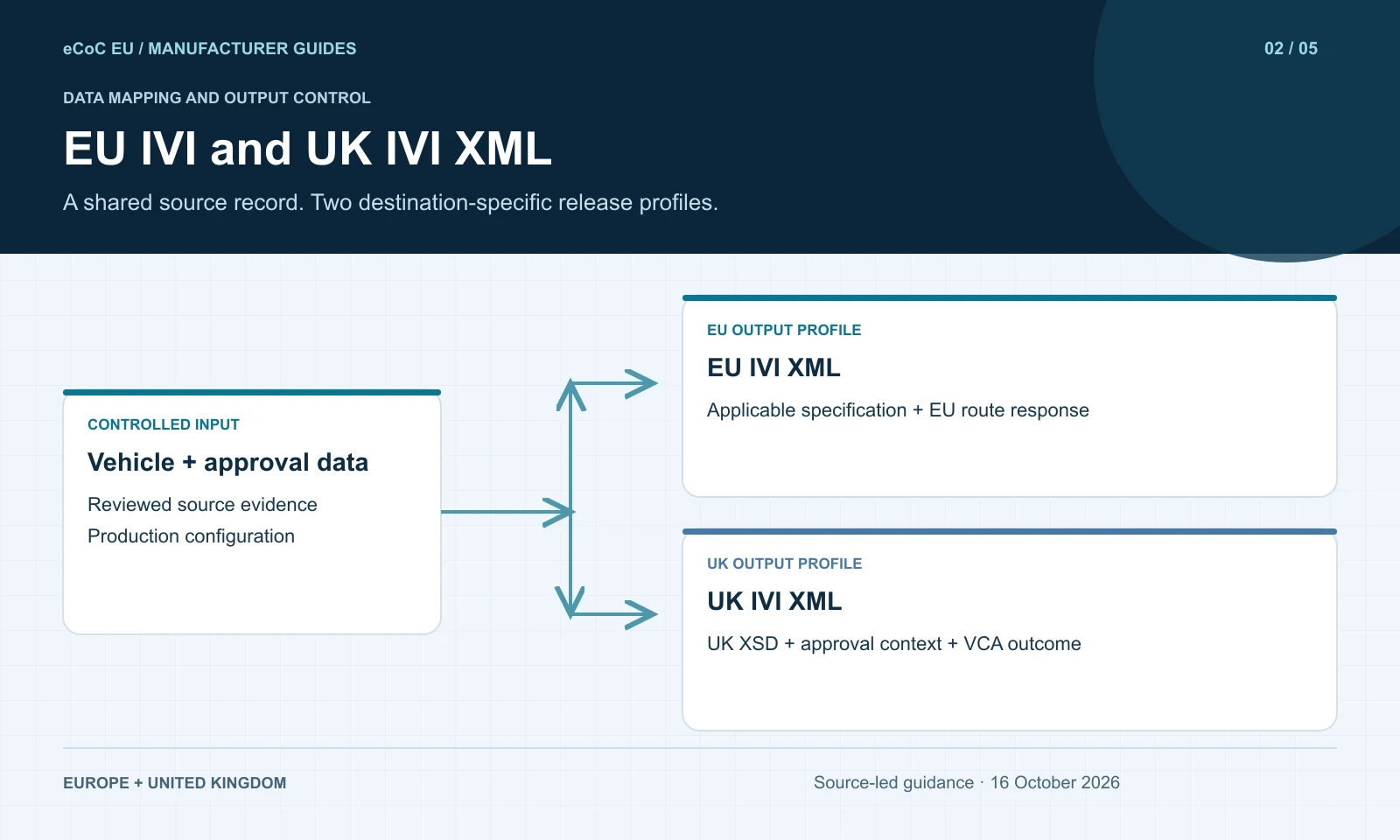
- Prepare the data. Map approved characteristics and individual production values to the required IVI version, keeping their provenance visible.
- Prove one release. Exercise data checks, XML generation, signing where applicable, submission and response handling using the agreed test environment.
- Exercise a failure. Show how an operator identifies a rejected record, corrects the source and confirms the next outcome.
- Agree the fallback. Document route-specific paper handling and escalation before the first affected vehicle leaves the factory.
For the wider operating model, use the eCoC and IVI knowledge hub. The implementation should give production, homologation and registration teams one agreed record of which requirement applies to each vehicle.
Example: one manufacturer, two delivery programmes
Consider a manufacturer preparing an EU-approved trailer programme and a separate GB-approved programme. The team should maintain two requirement profiles even if both use the same source database. Each profile records its approval basis, output specification, receiving account and test result.
A registration-market transition affecting the EU programme does not automatically change the GB profile. Equally, a successful UK submission does not prove EU availability. The release dashboard should expose these separate outcomes instead of presenting one global “eCoC complete” flag.
What should your implementation evidence contain?
Retain the source record, template revision, XML specification, signing result, transmission reference and receiving response together. Distinguish an internal validation pass from external receipt and from registration completion. This makes it possible to answer a customer query without reconstructing an email chain.
A useful acceptance meeting follows one real workflow, with sensitive identifiers redacted where appropriate. Ask the operator to find the vehicle, explain its applicable requirement profile and show what blocks release. Then repeat the exercise with a record needing correction.
Turn the timetable into an operating plan
Review eCoC software for manufacturer workflows alongside the EU NAP submission process and the separate UK VCA delivery workflow. Bring your approval schemes, vehicle categories, source-data format and intended first production date to the review.
Frequently asked questions
Has the EU eCoC legal deadline moved to 29 November 2026?
The consolidated EU framework checked for this guide still states 5 July 2026. National notices describe operational transitions. Their scope must be read separately from the legislation; a national announcement does not itself amend the EU legal text.
Does the UK threshold depend on manufacture or registration?
VCA guidance uses manufacture as the threshold. It says vehicles manufactured before 29 November 2026 do not need an eCoC submission solely because registration occurs afterwards. Check the approval scheme and any applicable exemption.
Does an eCoC software purchase complete compliance preparation?
Software selection is one part of readiness. Data mapping, manufacturer access, route-specific testing, release responsibilities and receiving-system outcomes still need to be established for the programme.
For the approval-scheme decision behind the timetable, continue with eCoC requirements for small-series manufacturers.
Official and technical references
These sources support the regulatory and technical statements in this guide. Always check the current consolidated text and the instructions of the authority responsible for your submission route.